The rapid development of artificial intelligence is creating unprecedented challenges for the global energy system, with AI energy consumption projected to grow by 320% by 2030, reaching 463 TWh, according to . The study shows that by 2030, AI will consume almost half of all data center electricity in the world, equivalent to Japan’s annual consumption, with only 40% of this energy coming from renewable sources. Although the AI energy revolution poses serious risks to the stability of power grids, including grid congestion and electricity price increases of up to 12% in some regions, technological innovations promise a six-fold increase in energy efficiency and a potential 5% reduction in global emissions through optimized power systems.
Current state of artificial intelligence power consumption
As of 2024–2025, data centers consume 550 to 700 TWh of electricity annually, with artificial intelligence accounting for 20–25% of this volume. Experts estimate that AI already consumes about 110–175 TWh of electricity, which is equivalent to the annual consumption of countries such as the Netherlands. The fact that artificial intelligence will account for 49% of the total energy consumption of data centers by the end of 2025 is particularly significant, indicating an exponential growth in demand.
One of the most energy-intensive aspects of AI is the process of training large language models. Training the ChatGPT-3 model used about 1,300 megawatt-hours of energy, which corresponds to the annual consumption of 130 American households. At the same time, according to OpenAI research, the power required to train AI models has been doubling approximately every 3.4 months since 2012.
Interactive queries to AI systems turn out to be much more energy-consuming than traditional web searches. A single query to a ChatGPT-like model consumes about 15 times more energy than a regular Google search. This emphasizes the dramatic difference between the energy needs of traditional IT services and modern AI applications.
For context, artificial intelligence may soon surpass Bitcoin mining in terms of energy consumption. This is especially important given that the cryptocurrency sector has long been a symbol of excessive energy consumption in the technology sector.
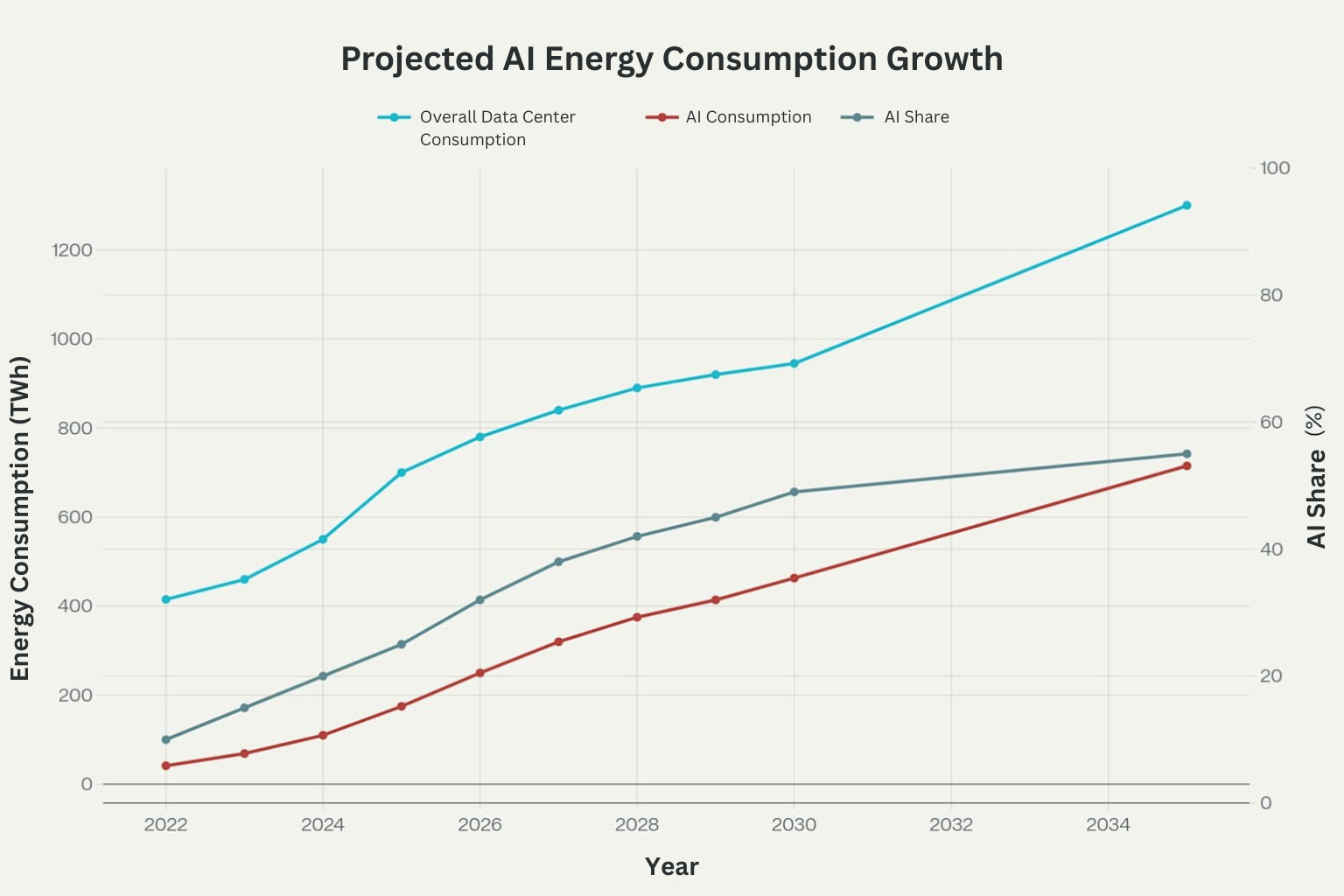
Growth of artificial intelligence energy consumption and its share in total data centre consumption
Forecasts of energy demand growth from artificial intelligence
The International Energy Agency predicts that global electricity consumption by data centers will double to 945 TWh by 2030 in the baseline scenario. At the same time, AI consumption will grow the most dramatically — to 463 TWh, which will be a 320% increase compared to 2024.
In the US, the situation is particularly critical: energy consumption by data centers will account for almost half of the total growth in electricity demand between 2025 and 2030. By 2030, the U.S. economy will consume more electricity for data processing than for the production of all energy-intensive goods combined, including aluminum, steel, cement, and chemicals.
Forecasts for the period up to 2035 show a wide range of possible development scenarios. In the baseline scenario, AI energy consumption could reach 1,300 TWh by 2035, which is roughly equal to India’s current consumption. However, depending on the pace of adoption and efficiency of technologies, this figure could range from 700 to 1,700 TWh.
According to forecasts, by 2035, the demand for electricity from AI could triple, reaching 1,200 TWh, which will pose particular challenges for countries with a high concentration of data centers, such as the United States.
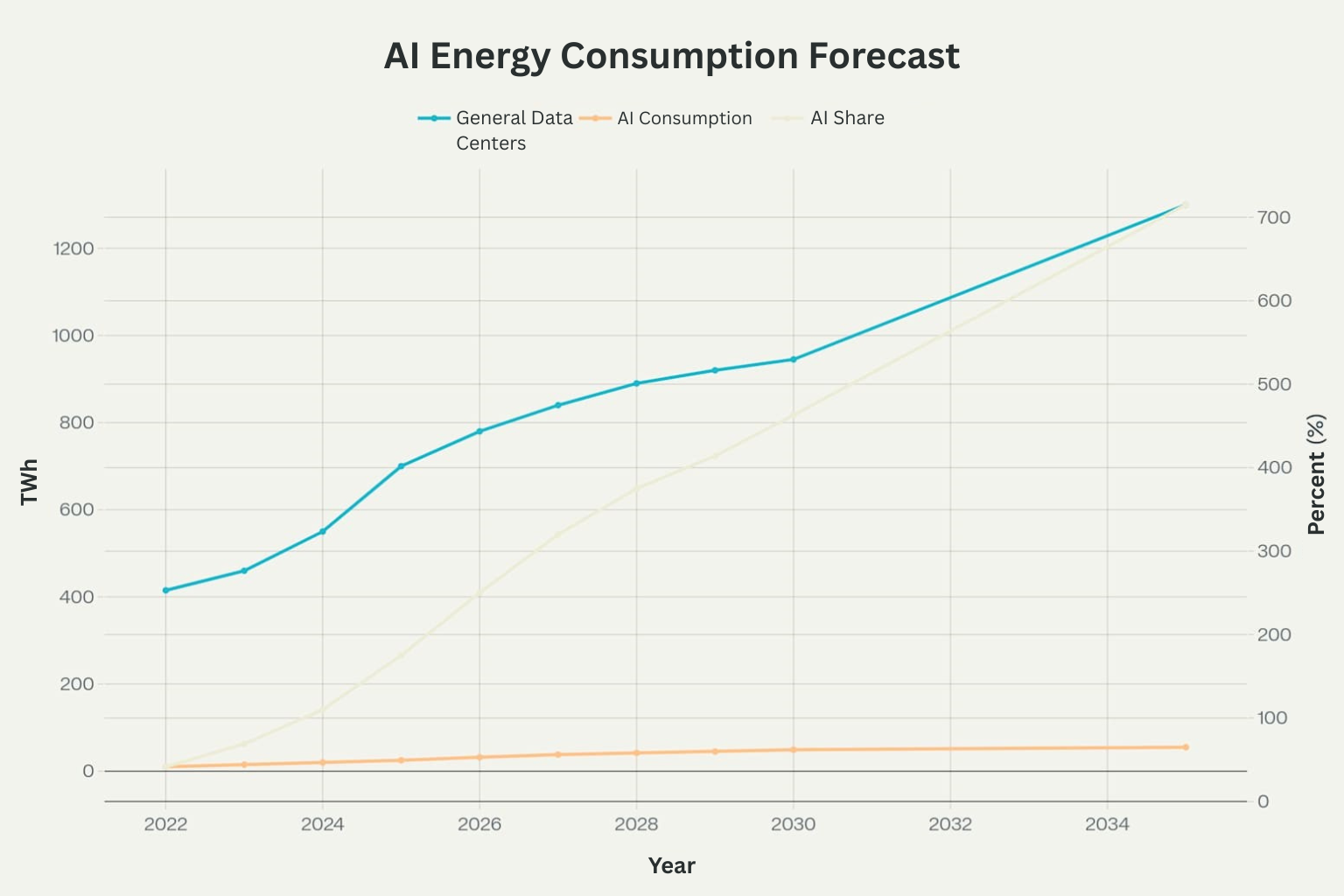
Projected growth in AI energy consumption by 2035
Regional distribution of AI power consumption
The United States and China together will account for 80% of global growth in data center electricity consumption by 2030. The United States leads the way in terms of absolute consumption, with a projected 380 TWh in 2030, accounting for 40% of global AI consumption.
China ranks second with 285 TWh (30% of global consumption), and the government is actively integrating the development of energy-intensive data centers into its national energy strategy.
Europe, despite lower absolute volumes (160 TWh in 2030), shows a steady growth of 33%. The Asia-Pacific region, including Japan and Malaysia, also shows significant growth to 95 TWh.
Different regions face unique challenges in powering AI infrastructure. In Northern Virginia, known as “Data Center Alley,” Dominion Energy will not be able to meet growing demand even with weakening power reliability guarantees. Starting with a capacity of 2,767 MW in 2022, demand is expected to reach 9,300 MW by 2028, while the infrastructure can only reliably support about 5,400 MW.
In Ireland, the situation is somewhat better: EirGrid will be able to meet the demand for AI over the next five years, even with the weakening of reliability guarantees to 99.6%.
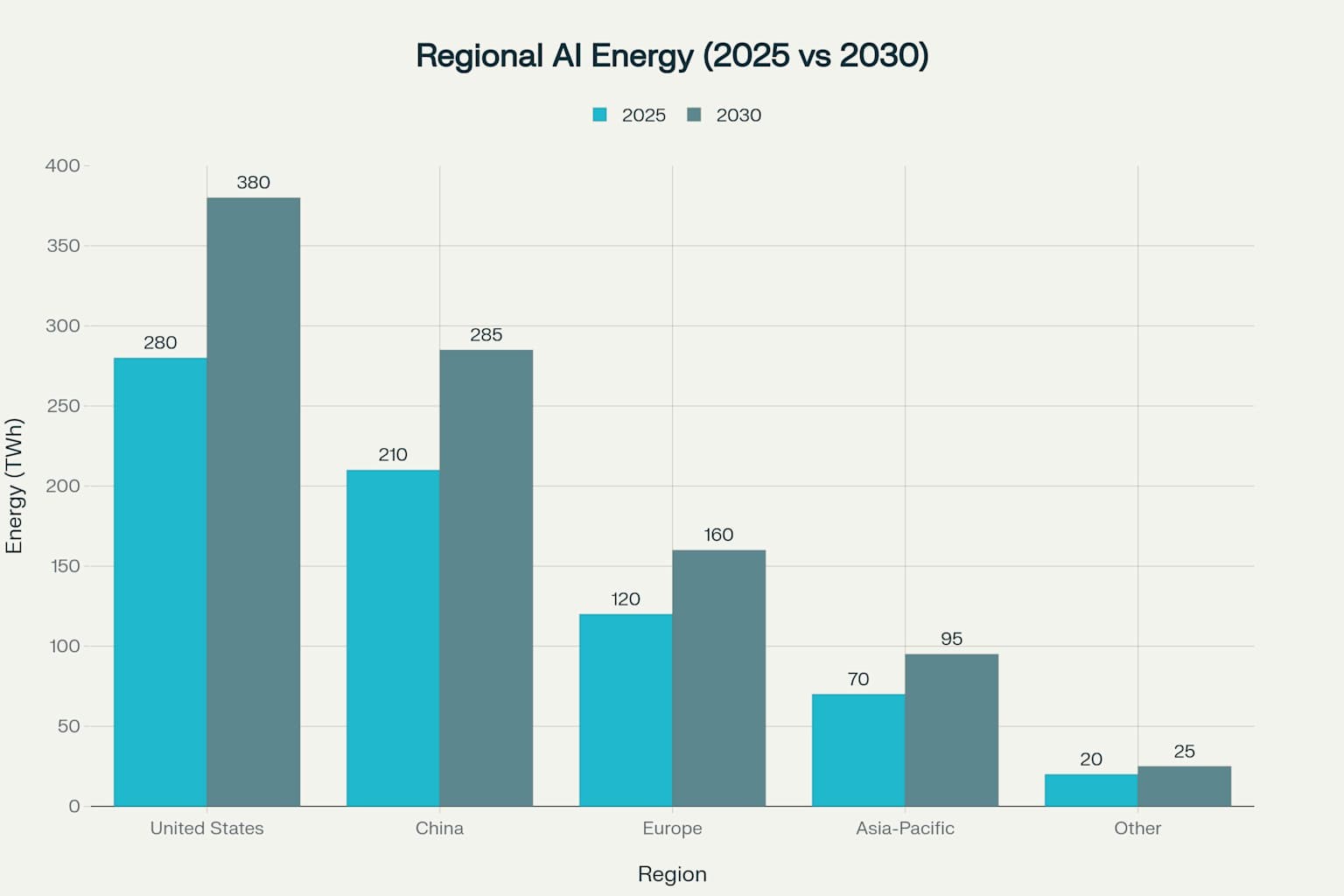
Comparison of regional AI energy consumption between 2025 and 2030
Energy sources for artificial intelligence
Forecasts for 2030 show that renewable energy sources will account for 40% (378 TWh) of AI’s total energy consumption.
Natural gas will remain the second most important source with a share of 35% (331 TWh), reflecting the need to ensure a stable baseload.
Coal, despite global decarbonization efforts, will still account for 15% (142 TWh) of the AI energy mix. Nuclear will account for 8% (76 TWh), with nuclear investments growing by 50% over five years, exceeding $70 billion in 2025.
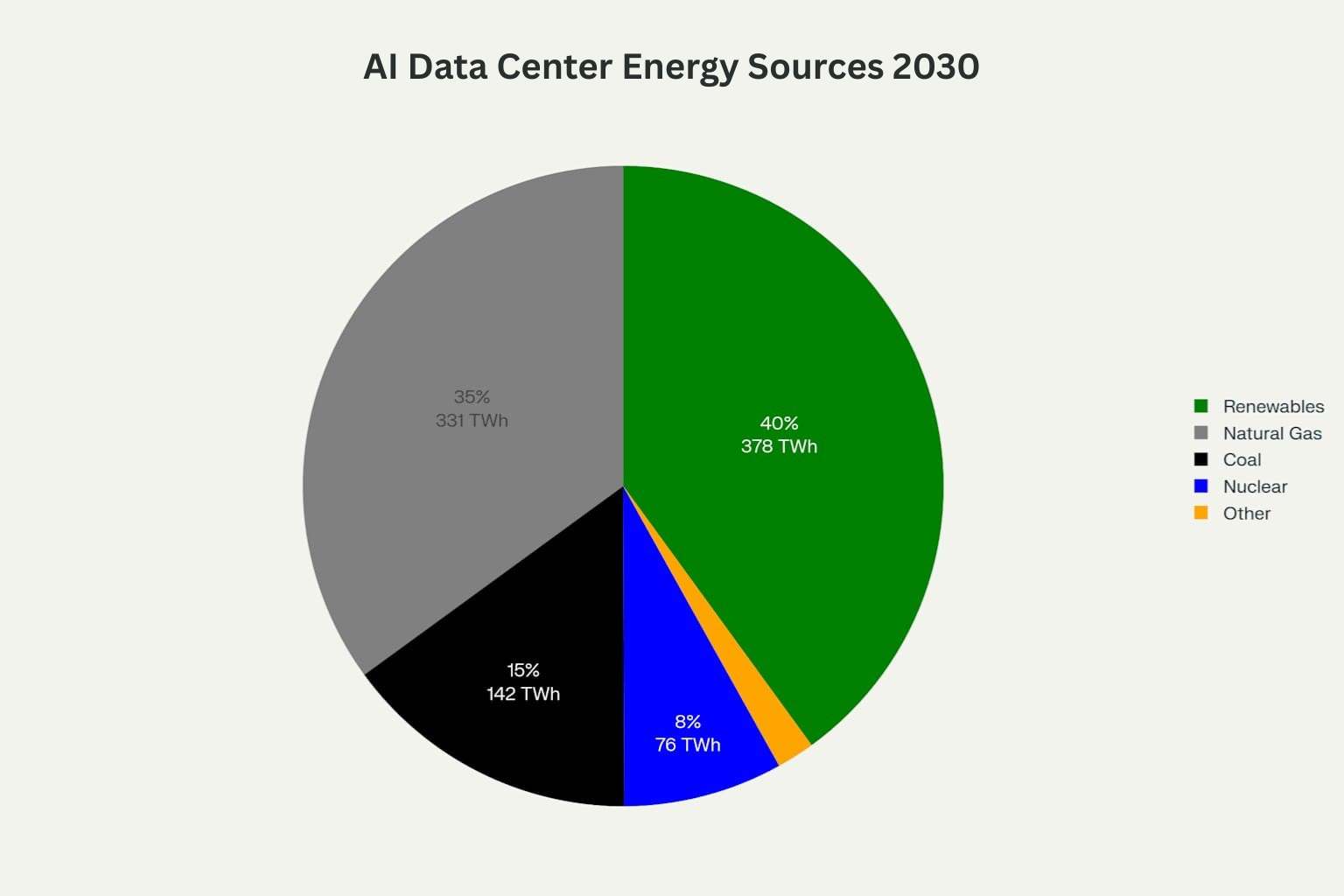
Distribution of energy sources for artificial intelligence in 2030
Many large AI data centers already use 100% renewable energy from solar and wind sources. Companies are actively signing agreements to purchase energy from wind farms located in regions with constant winds, including offshore wind farms.
China is coordinating the planning of data centers with energy infrastructure in regions rich in renewable resources, focusing on national hubs and resource-rich regions such as Qinghai, Xinjiang, and Heilongjiang.
Challenges for energy stability
A Bloomberg Energy Analysis study found that more than 75% of highly distorted energy readings in some regions are due to AI data center activity in the vicinity, affecting household appliances, industrial equipment, and grid reliability. This creates serious power quality issues that can lead to equipment damage, costly downtime, and customer dissatisfaction.
Unlike traditional computing workloads, which support relatively steady power consumption patterns, AI processing causes rapid, unpredictable fluctuations in energy demand, forcing the network to struggle to maintain reliable power.
The US power grid is not ready for a significant load growth, Grid Strategies warns. In Texas, power companies have warned that energy consumption by AI data centers could exceed available capacity by 2027. Georgia Power was recently forced to increase its winter demand forecast in megawatts by 38%, partly due to the state policy of stimulating computer operations.
In 2022, Dominion Energy was forced to stop connecting new data centers for about three months due to excessive electricity demand. The company expects demand in its service area to grow by almost 5% annually over the next 15 years.
The growing demand for electricity from AI data centers could lead to higher energy prices for consumers and industry. In Ohio, a major AI data center hub, residents saw a 12% increase in electricity prices in 2024 alone, partly due to the growing energy demand from AI computing infrastructure.
Technological solutions to increase efficiency
The most promising solution is the development of new AI chips based on entropy-stabilized oxides (ESOs), which can improve energy efficiency by up to six times compared to current industry standards. These chips, which mimic the way biological neural networks process information, allow computing and storing data simultaneously, minimizing data movement between memory and processor.
ESO-based memristors allow you to fine-tune memory capabilities by optimizing the ESO composition for specific AI tasks. This allows tasks to be performed with much lower energy consumption than a computer’s CPU.
Optimized cooling systems can provide a 30% improvement in energy efficiency over the period 2025–2026.
AI systems learn from IoT sensors to “understand” when a room is occupied and control the temperature to save energy while keeping people comfortable. A study at 45 Broadway in Manhattan found that the implementation of BrainBox AI reduced HVAC energy consumption by 15.8%, saving $42,000 annually and reducing CO2 emissions by 37 metric tons.
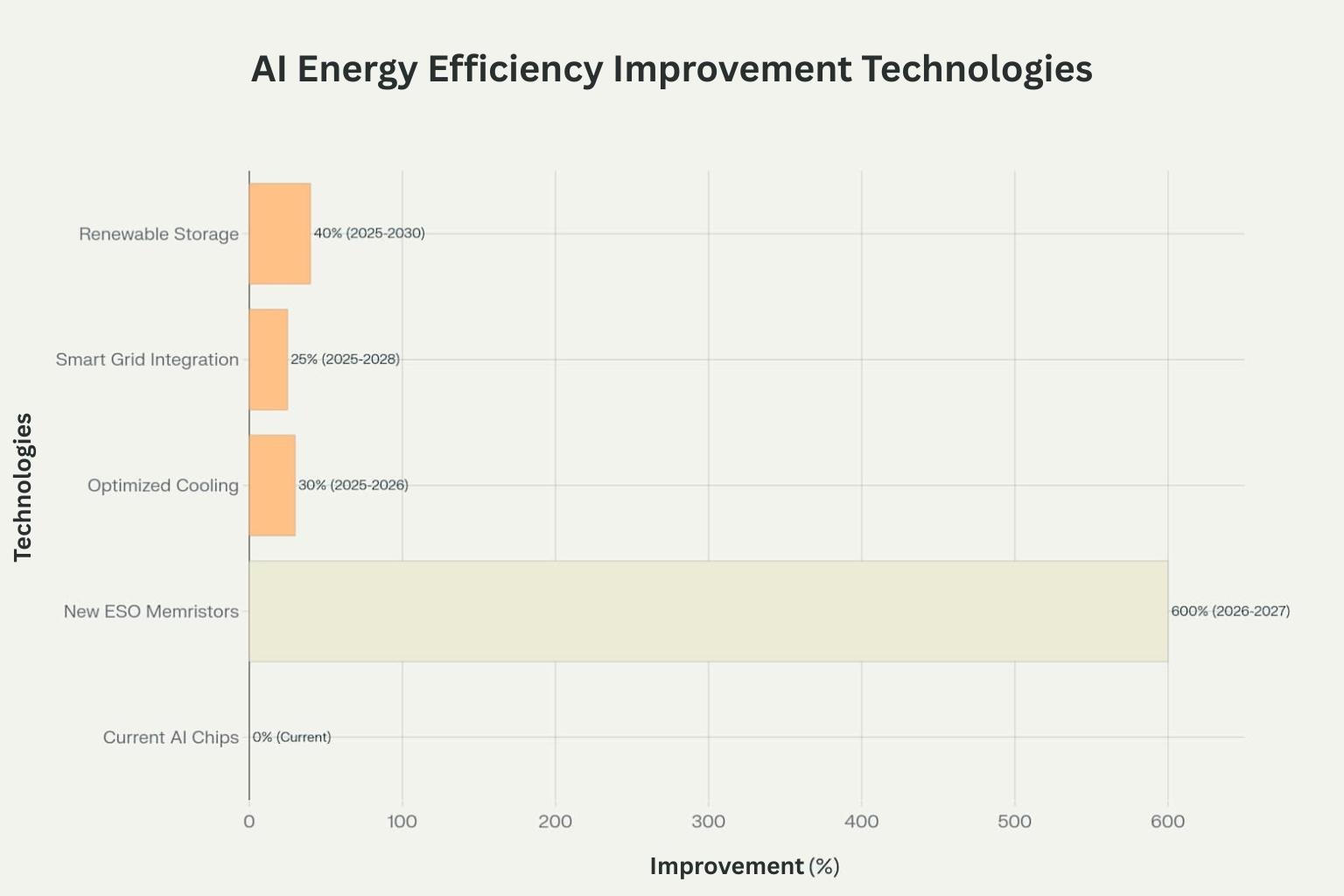
Potential of technological solutions to improve AI energy efficiency
Integration with smart grids can deliver a 25% efficiency improvement over 2025–2028. AI can play a key role in optimizing energy distribution and grid management by analyzing data from smart grids to predict demand fluctuations, optimize energy distribution, and balance supply and demand.
Small modular reactors (SMRs) are becoming a critical solution for powering AI infrastructure. SMRs offer several key advantages: flexibility of location in urban and rural environments, cost-effectiveness due to local installation, enhanced safety with modern safety systems, minimal greenhouse gas emissions, and faster development compared to traditional nuclear power plants.
The scale of energy consumption by AI operations is staggering: Meta’s new facility in Louisiana consumes twice as much electricity as all residential properties in Rhode Island combined. This underscores the need for sustainable and reliable energy solutions.
Some companies are exploring traditional nuclear solutions, such as restoring facilities like Three Mile Island, although this approach is not feasible for many organizations due to costs and logistical constraints.
Economic impact and investment
Global energy investment sets a record of $3.3 trillion in 2025 despite challenges from heightened geopolitical tensions and economic uncertainty. Clean technology investments attract twice as much capital as fossil fuels, reaching a record $2.2 trillion in 2025.
Solar energy has become the largest single item in the IEA’s list of global investment spending, surpassing investment in oil production. Solar photovoltaic systems will attract $450 billion, making them the largest category of energy investment in the world.
The Global AI Infrastructure Investment Partnership (GAIIP), a coalition of BlackRock, Global Infrastructure Partners, Microsoft, and MGX, aims to mobilize $100 billion to develop next-generation data centers and related energy infrastructure, primarily in the United States and allied countries. The four largest U.S. cloud service providers have pledged to spend more than $200 billion, a 50% increase over the previous year.
The AI-fueled energy transition could create up to 250,000 new jobs. This includes positions in the development of renewable technologies, construction of energy infrastructure, data center maintenance, and power system management.
Potential benefits of AI for energy efficiency
Despite its high energy consumption, AI also offers significant opportunities for energy savings in other sectors. AI is already making energy generation, distribution, and use more efficient, and the authors expect these savings to accelerate. Existing AI algorithms predict energy generation and consumption, which could lead to a reduction in global emissions of about 5%.
AI can help find efficiencies in large-scale energy systems and industrial processes. In the transportation sector, AI can improve the operation and management of vehicles, which can reduce energy consumption. AI also has applications in reducing condensation footprints and optimizing routes.
In the building sector, AI-enabled HVAC systems optimize consumption by learning user habits and adjusting operations accordingly . In manufacturing, AI-powered “machine vision” quickly detects defects and reduces unnecessary energy consumption from additional manual effort and wasted materials.
Outlook to 2035 and strategic recommendations
By 2035, AI energy consumption could range from 700 to 1,700 TWh, depending on the development scenario. The baseline scenario assumes 1,300 TWh, which is equivalent to India’s current consumption. This creates both challenges and opportunities for the global energy system.
To ensure energy sustainability, it is necessary to accelerate renewable energy permits, as the construction of new data centers can be a quick process compared to the years required to obtain clean energy permits. This creates an obstacle for data centers seeking to reduce their dependence on fossil fuels.
Investments in network infrastructure are critical to support the growing demand. The development of energy-efficient technologies for AI equipment can significantly reduce the overall energy consumption of the sector.
Policy coordination between the energy and technology sectors is becoming increasingly important. Countries in the Baltic region are demonstrating a successful model for integrating AI into energy transformation, using AI to assess overhead lines, remotely monitor systems in real time , optimize transmission capacity, and support renewable energy forecasting.
Conclusions
The rapid development of artificial intelligence poses fundamental challenges to global energy stability, with energy consumption projected to grow by 320% by 2030. Current energy capacity is insufficient to fully meet future AI needs, especially in key regions such as Northern Virginia and Texas.
However, technological innovations, including revolutionary ESO memristors with six times the efficiency and integration with renewable energy sources, offer pathways to a sustainable future. A coordinated approach that combines accelerated investment in energy infrastructure, the development of efficient technologies, and international cooperation is critical to ensure that the AI revolution does not undermine global energy security.
The next ten years will determine whether humanity will be able to successfully balance the needs of technological progress with the requirements of energy stability and climate goals. The success of this balance will depend on the speed of implementation of innovative solutions and the effectiveness of international coordination of energy policy.
Sources used
- https://www.iea.org/reports/energy-and-ai/energy-demand-from-ai
- https://www.iea.org/reports/energy-and-ai
- https://www.deeplearning.ai/the-batch/the-international-energy-agency-examines-the-energy-costs-and-potential-savings-of-the-ai-boom/
- https://www.lemonde.fr/en/les-decodeurs/article/2025/06/14/artificial-intelligence-consumes-massive-amounts-of-energy-here-s-why_6742347_8.html
- https://cybernews.com/news/ai-data-center-power-consumption/
- https://www.linkedin.com/pulse/impact-ai-data-centers-electric-power-grid-asad-mujeeb-阿萨德--ibyoc
- https://www.forbes.com/sites/feliciajackson/2025/04/14/ais-energy-dilemma-can-tech-drive-a-sustainable-energy-future/
- https://scitechdaily.com/600-boost-scientists-develop-game-changing-ai-chip-with-impressive-energy-efficiency/
- https://www.polytechnique-insights.com/en/columns/energy/generative-ai-energy-consumption-soars/
- https://www.theverge.com/climate-change/676528/ai-data-center-energy-forecast-bitcoin-mining
- https://cacm.acm.org/news/controlling-ais-growing-energy-needs/
- https://www.technologyreview.com/2025/05/20/1116327/ai-energy-usage-climate-footprint-big-tech/
- https://www.youtube.com/watch?v=IzUk56GWWRk
- https://www.iea.org/news/ai-is-set-to-drive-surging-electricity-demand-from-data-centres-while-offering-the-potential-to-transform-how-the-energy-sector-works
- https://carboncredits.com/ais-energy-hunger-data-centers-set-to-use-power-equal-to-japans-by-2035/
- https://newsflash.tdsynnex.co.uk/artificial-intelligence/ai-power-demands-to-quadruple-but-could-transform-energy-market/6720
- https://www.energycentral.com/energy-biz/post/ai-s-power-problem-how-artificial-intelligence-reshaping-energy-grid-itriSIPG8IWL1e3
- https://group.voltalis.com/en/press-releases/ai-is-a-challenge-for-the-energy-transition-but-above-all-a-condition-for-its-success-10198
- https://www.iea.org/reports/energy-and-ai/ai-for-energy-optimisation-and-innovation
- https://www.scmp.com/economy/china-economy/article/3313194/china-hopes-power-ai-boom-green-energy-new-data-centre-strategy
- https://epic.uchicago.edu/insights/some-grids-wont-meet-the-power-demands-of-ai-datacenters/
- https://techblog.comsoc.org/2024/03/16/ai-sparks-huge-increase-in-u-s-energy-consumption-and-is-straining-the-power-grid-transmission-distribution-as-a-major-problem/
- https://www.climateaction.org/news/global-energy-investment-to-hit-record-3.3-trillion-in-2025
- https://www.rcrwireless.com/20250402/fundamentals/ai-data-centers-5
- https://www.hitachienergy.com/news-and-events/blogs/2025/03/ai-load-impact-on-data-centers-adapting-to-the-future-of-infrastructure
- https://www.corinex.com/articles/ai-is-fueling-a-data-center-electricity-surge-but-grid-is-not-ready
- https://www.marketresearchfuture.com/news/ai-reinvents-energy-efficiency-in-building-designs-2025-a-novel-approach-to-clean-energy-transition
- https://www.powerelectronicsnews.com/industry-examines-nuclear-energy-to-power-data-centers-and-ai-workloads/
- https://www.entrepreneur.com/finance/small-modular-reactors-emerge-as-critical-power-solution/484448
- https://www.iea.org/news/global-energy-investment-set-to-rise-to-3-3-trillion-in-2025-amid-economic-uncertainty-and-energy-security-concerns
- https://www.iigcc.org/insights/world-energy-investment-2025-highlights-electricity-demand-and-energy-security-new-drivers
- https://5c.ai/blog/ai-infrastructure-2025s-key-investment
- https://reports.weforum.org/docs/WEF_Artificial_Intelligences_Energy_Paradox_2025.pdf
- https://w.media/data-centers-powering-the-ai-boom-but-can-they-go-green/
- https://freepolicybriefs.org/2025/06/02/ai-energy-transition/